
This page has a short description of each chapter in the book, China: Insight into History, Culture and People
Scroll down to see all chapters
Chinese Culture Introduction
A quick look at Chinese culture
This chapter provides an overview of Chinese culture discussing topics including how China's unique language affects their culture, what are the impacts of centuries of imperial rule, we talk about Chinese names and describe social media in China today.
Cultures are living entities, constantly evolving under the influence of many factors. History, geography, climate, survival strategies, spiritual beliefs, art, language, social structures, and interactions with other cultures all leave their mark. In the case of China, with a history spanning at least four thousand years, this evolution has been profound and multifaceted. From the fertile plains of the east to the towering mountains of the west, China's diverse geography has shaped its agricultural practices, settlement patterns, and even its artistic traditions. In contrast, the United States, while possessing a rich and complex history of its own, has a cultural narrative interwoven with the tragic displacement and cultural erasure of its Indigenous peoples. European colonization, the transatlantic slave trade, and waves of immigration have all contributed to the vibrant mosaic of American culture. By understanding the forces that shape cultures, we can gain a deeper appreciation for the unique tapestry of Chinese society.
We discuss various influences on Chinese culture including the Chinese language, millennia of imperial rule as well as modern influences.
Dynasties
Study of Chinese Dynasties gives us an understanding of Chinese History

For thousands of years, the story of China has been interwoven with the rise and fall of imperial dynasties. These successive reigns of families, some lasting centuries, have shaped the nation's identity, culture, and political landscape. Join us as we take you through China's dynasties starting with the Xia dynasty about 2000 years BCE through the fall of the last imperial dynasty, the Qing dynasty in 1912. We write about the highlights of each dynasty and the influence on China including commerce, art and history.
This is an image of a Shang dynasty (1600-1050 BCE) bronze ding which is an ancient Chinese cauldron standing on legs with a lid. They were an important shape used in Chinese ritual bronzes.
Century of Humiliation
Chinese history in the 19th and early 20th century

This part of China's history still has a significant influence on China, it's people and China's influence in the modern world. As we explain, the period of time from 1839 to 1945 marks a period where the Chinese nation was continuously at war with foreign powers, which led to massive losses of people, territory, and sovereignty. During the seventeenth and eighteenth centuries, China was actually considered a world power especially considering economic might. However, during the nineteenth century, China began to weaken as a result of many conflicts inside and outside of China. People outside of China should not underestimate the cultural and political aspects of this history.
The image is an illustration of the Canton harbor at the start of the First Opium War. At that time the only port open to foreign traders was the Canton port, which is present day Guangzhou. China established a trading system called the Canton System which served as a way for the Qing dynasty to control trade with the West. Chinese merchants managed all trade in the port. The buildings were called factories and were located on the banks of the Pearl River. The Opium Wars started because England and other powers were bringing opium into China. The drug was illegal in the UK and caused great social problems in China. China tried several times to stop the opium trade which led to British parliament declaring war on China.
In this chapter we cover the Opium Wars, Foreign Occupation, the First Sino-Japanese War and the Japanese invasion and occupation during World War 2 including the Rape of Nanjing.
Rise From Postwar to Global Superpower
How China became such an influential power affecting geopolitics of today
Chinese history since the end of World War II is a story of remarkable transformation, marked by periods of intense struggle, radical change, and ultimately an astonishing rise to global prominence. This chapter provides an overview of this complex history including the disastrous Great Leap Forward, the Cultural Revolution and Reform and Opening Up which led to today's modern China. We continue with a discussion of economic liberalization, Special Economic Zones, and poverty reduction. We also discuss the One Child Policy and it's effect on society. The chapter concludes with China's rise under the leadership of Xi Jingping.
Chinese Traditional Architecture
Traditional architecture is an important part of Chinese history and culture
In this chapter, we discuss architecture. We discuss the most important aspects of Chinese architecture with a focus on traditional architecture. Chinese architecture is an expression of an ancient style distinguished by inclusion of open areas, bilateral symmetry, a horizontal focus, Feng Shui, special roof structures, and more. China has a rich history of woodworking dating back to the Shang Dynasty (1600-1046 BCE) where wood tools and utensils were found in ancient tombs.
One of the most interesting aspects of traditional Chinese architecture is the Enclosed Courtyard houses.

This chapter also includes a discussion and photos of traditional Chinese gardens
Tea Culture
Tea is a big part of Chinese Culture and has a long history

Currently, nearly three billion people in over 160 countries and regions worldwide enjoy drinking tea, and China is the world's largest consumer of tea, with 47.5 percent of Chinese consumers maintaining a daily tea drinking habit. Tea has a history of thousands of years in China and has gradually evolved into a cultural symbol. In this chapter, we will discuss the tea culture in China. Chinese tea culture includes many facets. Physically, it includes tea cultivation, brewing, serving, consumption, arts, and ceremonial aspects.
Reading this chapter, you will learn that all different types of tea come from the same plant but white tea, green tea, yellow tea, oolong tea and black tea are processed in different ways. We also cover the best way to brew each different type of tea.
The image is a typical a Tang Dynasty tea house, where the bustling city fades into a soft, quiet atmosphere. The air itself is thick, not with smoke, but with the intoxicating, earthy smell of crushed tea leaves being toasted and steamed, a scent that is the very heart of Chinese culture. The atmosphere is one of relaxed, artistic contemplation. The Tang era tea house is a place of gentle sensory pleasures where poets and scholars gather.
The Four Great Inventions of China
Despite popular myth, China has a long history of inventions that changed the world

There are four inventions that were made in China which have had a profound influence on the entire world. The term "Four Great Inventions" was not suggested by Chinese people but rather by an Englishman, Francis Bacon, who wrote in the seventeenth century, "Chinese people have three inventions that changed the world." The term "Four Great Inventions" was actually named by British historian and sinologist, Joseph Needham. He spent a good portion of his life collecting and documenting examples of Chinese inventions and technology. He published his first book on the subject in 1954 where he listed many Chinese inventions which were originally thought to be European inventions. We will detail what is known about these four inventions and briefly discuss some other significant Chinese inventions. The Four Great Inventions are the compass, gunpowder, paper making, and printing technology.
The image is a reconstruction of an early Chinese compass. A spoon made of lodestone, its handle pointing south, was mounted on a brass plate with astrological symbols. These primitive compasses were used by Chinese military and sailors for direction finding as early as 200 BCE.
Traditional Chinese Medicine
Traditional Chinese Medicine consists of healing practice as well as disease prevention

This is an opportunity to learn about what the West calls traditional Chinese medicine. We provide an overview of traditional Chinese medicine practice as well as a brief history. We discuss the Chinese holistic view of the body and outline the key components of TCM including acupuncture, herbal medicine, cupping and moxibustion, dietary therapy, and exercise and movement.
One aspect of TCM is the relationship of five elements to the human body, The five elements are metal, wood, water, fire, and earth. The five elements are not just physical elements but represent dynamic forces interconnected in a system. The diagram helps explain how the universe, nature, and the body function in a balanced and interconnected way. There is a generating cycle shown where elements nourish and support each other. Wood nourishes fire, fire nourishes earth, earth nourishes metal, metal nourishes water, and water nourishes wood.
The five elements are also connected to the human body. Each element is associated with specific organs and energy pathways. Wood corresponds to the liver and gallbladder, fire to the heart and small intestine, earth to the spleen and stomach, metal to the lungs and large intestine, and water to the kidneys and bladder. Each element also relates to emotions, colors, tastes, seasons, and other aspects of life. Imbalances in any element can manifest as physical or emotional symptoms.
Traditional Festivals
Traditional Chinese festivals are an important part of Chinese culture
In this chapter, we introduce Chinese traditional festivals. The ancient traditional festivals have rich cultural meaning and a long colorful history.

Most festivals started during the Qin Dynasty (221-206 BCE) which was the first unified dynasty. By the Han Dynasty (206 BCE - 220 CE), China had experienced a great development period, and major traditional festivals were already part of life. During the prosperous Tang Dynasty (618-907 CE), traditional festivals no longer included primitive sacrifice, taboo, and mystery and became more entertaining. From then on, festivals became brisker and more exciting; more and more folk customs were developed, many of which are still followed today. We introduce the basis of the Chinese calendar, the twenty-four solar terms. All traditional festivals are based on this calendar. Then we describe Spring Festival, Lantern Festival, Qingming Festival, Dragon Boat Festival, Double Seventh Day, Chongyang Festival and we end with the important New Year's Eve celebration.
The image celebrates the Double Seventh Day which is similar to Western Valentines Day. The legend of the Cowherd and the Weaver Girl originated from people's worship of the natural celestial phenomena. In ancient times, people mapped the sky. In the ancient constellation system, the "Ox constellation" was composed of six stars located on the east side of the Milky Way, resembling two inverted triangles. These stars formed a cow with two horns on its head but only three legs, hence the ancient people called it "Leading a cow". The three stars of Weaver Girl are located in the northern part of the ox constellation, and the number star is the fifth brightest star in the sky. On a clear summer or autumn night, the stars twinkle in the sky, and a Milky Way runs across the north and south. On both sides of the Milky Way, there is a shining star, facing each other across the river, which are the Altair and the Vega stars. According to folk legend, on the night of double seventh day every year, the Weaver Girl and Cowherd meet at the Magpie Bridge in the sky. The Weaver Girl is a beautiful, intelligent and dexterous fairy. On this night, the girls lay seasonal fruits in front of the bright moon, offering sacrifices to the heavens, begging the goddesses in the sky to endow them with intelligent hearts and dexterous hands, making their knitting techniques skillful, and even begging for a perfect match in love and marriage.
Chinese Literature
Chinese literature includes lyric poetry, historical and didactic writing, drama, and various forms of fiction

Chinese literature, has a rich history spanning over five millennia, it mirrors the profound cultural, social, and political transformations that have shaped China. This chapter highlights key representative works from various eras dating back to the Qin dynasty (221-206 BCE) through contemporary Chinese literature. We discuss poems and poetry, Chinese Opera, classic novels as well as contemporary authors.
Chinese ancient poetry is renowned for its beautiful language, profound artistic conception, and rich emotions. Ancient poetry expresses rich connotations through concise and lively language, showcasing the profound cultural heritage and delicate emotional expression of China. The artistic conception in ancient poetry is often rich in philosophy and emotion, which can resonate with readers. In ancient poetry, various artistic forms, such as music and painting, are often integrated, making poetry rich in expressive power and charm.
The image is Li Bai, along with one of his poems. Li Bai was the great romantic poet of the Tang Dynasty. He had an extremely high status and was later hailed as the "Poet Immortal." He wrote about 980 poems in his lifetime. His style was bold and unrestrained, rich imagination, and wonderful artistic conception. Li Bai was acclaimed as one of the greatest and most important poets of the Tang Dynasty and in Chinese history.
Chinese Characters
Chinese characters are logographs used to write the Chinese languages
Chinese characters called hànzì, are a mysterious, intricate drawing of lines and dots that has captivated and challenged learners for centuries. This chapter offers a glimpse into this fascinating writing system, one of the oldest in the world. While mastering Chinese requires dedicated study, this chapter will illuminate the fundamental principles behind its characters, demystifying their structure and meaning. At the end of the chapter, we provide a list of sources for further study. The Chinese writing system does not use an alphabet like Western languages. Chinese uses a series of symbols. The earliest known form of Chinese writing is the Oracle Bone Script, which dates back to 1250-1200 BCE during the Shang Dynasty. These characters were inscribed on tortoise shells and animal bones.

As an example of one character, the image shows the stroke order for the character xiang meaning think, ponder, suppose, consider.
Chengyu
Chengyu are the Chinese version of idioms

Chengyu is a short concise expression, usually consisting of four characters. They are very similar to idioms in the English language. Chengyu is a unique and essential part of the Chinese language. Despite their brevity, chengyu often convey moral teachings, complex ideas, historical references, or philosophical concepts. They originate from various sources, such as ancient literature, historical events, folklore, and philosophical teachings. Chengyu are deeply embedded in Chinese culture and are commonly used in both written and spoken language.
Here is an excerpt from this chapter. The four character phrase pronounced lao ma shí tú is a widely used chengyu. It literally means, "an old horse knows the way." Here is the story behind it. During the Spring and Autumn Period (770-476 BCE), the state of Qi's army, led by Gen. Guan Zhong, set out on a military campaign. On their return journey, they became lost in a vast, unfamiliar wilderness. With no clear path back, the soldiers began to panic, unsure of how to proceed. Guan Zhong had a clever solution, to use the oldest horses in the army and allow them to lead the way. The old horses successfully guided them out of the wilderness and back to safety. This chengyu symbolizes the value of experience and wisdom. Today it is used to stress the importance of relying on seasoned individuals who, like the old horses in the story, possess the insight and knowledge needed to navigate complex or difficult situations.
Calligraphy
Part of Chinese culture is the beautiful, artistic Chinese calligraphy

The most influential art form in China has been calligraphy or shufa. Writing has been important throughout Chinese history. As an esteemed art form, calligraphy surpassed other visual arts, including painting and sculpture. Much like poetry, writing is a means of artistic expression reflecting the power of the written word in ancient Chinese society. Calligraphy was seen as a way to preserve the authority of emperors and scholars. Proficiency in calligraphy was expected of educated people (mostly men), signifying social status and refinement. The unique visual form of Chinese characters made calligraphy a crucial part of the language itself. Brushwork and philosophy of calligraphy had a major influence on Chinese painting styles. We describe the five major forms of calligraphy.
The imperial examination was a civil service examination system in Imperial China administered for the purpose of selecting candidates for the state bureaucracy. A large part of the Imperial Examination process was to demonstrate proficiency in calligraphy.
The image is a photo of calligraphy done by the author's father Wang Yinghui. This style of calligraphy is called running script.
There is a lot of synergy between calligraphy and painting. There is direct evidence of China's two major art forms, calligraphy and painting dating back to the Eastern Zhou Dynasty (771-256 BCE). Calligraphy and painting share common tools and materials; that is: brush, ink, silk, and paper. Choices of these tools influenced aesthetics, particularly brushes which are sensitive to pressure of the hand. A light touch produces a line whereas a heavier pressure produces thicker line or when used sideways a swath. The aesthetic of traditional Chinese art stemmed from an appreciation of the myriad effects of brush and ink in the hands of an artist.
Art in China
Chinese art is yet another important part of Chinese culture
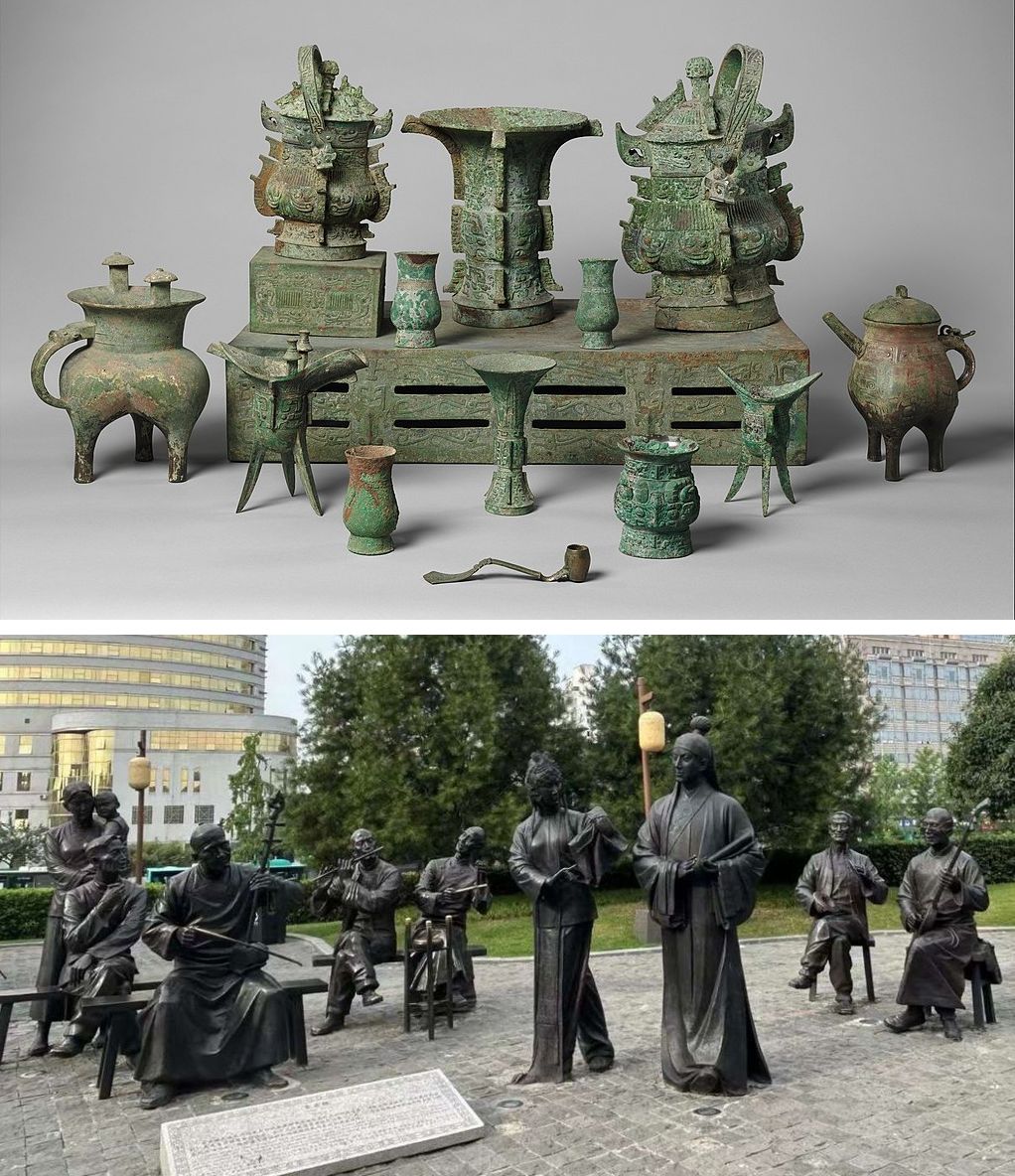
Learning about Chinese art is a journey through history and culture. China's artistic heritage spans thousands of years, encompassing a diverse array of styles, mediums, and cultural influences. Rooted in a rich tradition of philosophy, religion, and history, Chinese art reflects the values and aesthetics of one of the world's oldest civilizations. From ancient pottery to modern avant-garde movements, the evolution of Chinese art mirrors the changing dynamics of society, politics, and cultural exchange.
The two images are an assortment of bronze wine vessels from the Western Zhou dynasty (1046-771 BCE) and below is a modern sculpture of some Tang dynasty (618-907) figures. The sculptures are in Xi'an at a city park along the ancient city wall.
We start the discussion about art with the formative phase of Chinese civilization from the Late Neolithic era (about 3000 to 2000 BCE) to the Bronze Age (about 2000 to 1000 BCE). We discuss the golden period of Chinese art, the Tang and Song (960-1279 CE) dynasties. Artists during this period mastered ink wash painting, creating light and delicate landscapes that conveyed both the physical and spiritual beauty of nature. Figures, such as Fan Kuan and Guo Xi, became renowned for their monumental landscapes.
We discuss and have photos of ceramics where China left an indelible mark on global art history. We conclude this chapter with a discussion of modern and contemporary art.
Chinese Cuisine
Chinese cuisine has a rich history evolving through many dynasties and cultural influences
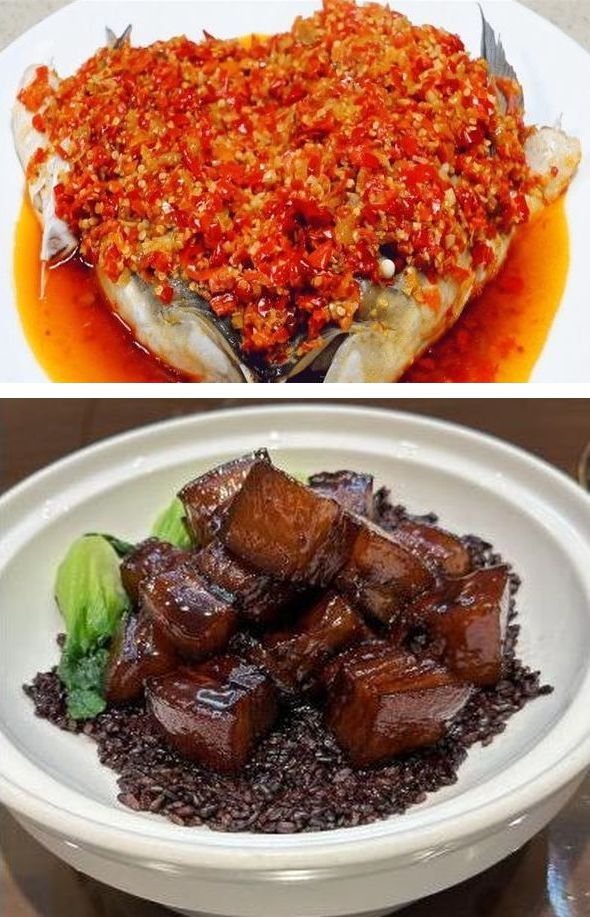
The roots of Chinese cuisine can be traced back more than five thousand years. Ancient Chinese diets were mostly rice, millet, and other grains, along with vegetables and occasionally meat. As time went by, Chinese cuisine evolved and developed into a complex and diverse culinary art form. Only a few decades ago, meat and fish were rare luxuries. Chinese people mostly subsisted on a diet that consisted primarily of rice or noodles along with some vegetables. Today that is a distant memory; most people consume meat and fish on a daily basis. However, staples like rice or noodles remain integral parts of Chinese diets.
The first image is Chopped Pepper Fish Head which is a dish made with a pickled fish head topped with fresh and spicy chopped peppers. Chopped pepper fish head originates from Hunan Province. The second image is the infamous Hong Shao Rou, or red braised pork belly made by slow-cooking pork belly in a mixture of soy sauce, sugar and spices.
We discuss regional variations and include a map of China showing where the eight major cuisines originated. Regional variations of Chinese food developed because of the size of the country, with each province having its own unique ingredients, cooking techniques, and flavors. Chinese people traditionally used what was available locally. We also talk about breakfast food.
Today Chinese cuisine is popular all over the world and has been adapted to suit local tastes and ingredients. But the roots of Chinese cuisine are still an integral part of the country's cultural heritage and culinary traditions. Chinese cuisine has diverse and unique flavors, largely due to the regional variations of Chinese food. In a country as large as China, and with the difficulty of travel in ancient times, different areas developed their own unique dishes and cooking styles over the centuries.
Chinese Philosophers
Chinese philosophy is the philosophical traditions that developed in the historical and cultural context of China
Chinese philosophy is shaped by three major schools: Confucianism, Taoism, and Legalism, each offering distinct perspectives on society, governance, and human nature. Confucianism emphasizes moral virtue, social harmony, and the importance of hierarchical relationships. It advocates for cultivating personal ethics, respect for tradition, and the pursuit of a just and orderly society. Taoism, rooted in the teachings of Laozi, focuses on living in harmony with the Tao (the Way), which represents the natural order of the universe. It encourages simplicity, spontaneity, and aligning oneself with nature's rhythms rather than striving for control. Legalism prioritizes strict laws, centralized authority, and the use of reward and punishments to maintain order. It views human nature as inherently self-interested and asserts that a strong, disciplined state is necessary for stability. Together, these schools reflect a rich and diverse intellectual tradition that has profoundly influenced Chinese culture and governance.
As Confucius said, "By three methods we may learn wisdom: First, by reflection, which is noblest; Second, by imitation, which is easiest; and third by experience, which is the bitterest." In this chapter we start with ancient Chinese philosophers including Confucius, Mencius and Sun Tzu discussing their works and their influence on China and beyond. We conclude with two relatively modern philosophers, Sun Yet Sen and Mao Zedong.
Concubines in Chinese History
Concubinage is a multifaceted aspect of Chinese history and culture, reflecting issues of gender, power, and social structure
Through most of its history, China was an imperial monarchy. During these times, concubines played a large part in Chinese culture.

Concubines are what we call mistresses, and in ancient China, polygamy was considered normal and socially acceptable for emperors, noblemen, and the rich. The vast majority of Chinese people could not have concubines, but it was common for successful men to have at least one concubine in their household. In these households, the status of concubines was never higher than official wives. The purchase of a concubine was similar to the purchase of a servant or slave, yet concubines had a higher social status. In the earliest time, a man could have as many concubines as he could afford. From the Eastern Han period (25-220 CE) onward, the number of concubines a man could have was limited by law.
In the royal family, emperors were expected to bear male sons in order to carry on the imperial line. Rather than leave it to chance by having only one wife, concubines were used to ensure that several male offspring were produced. This was especially important because in ancient times, many males did not survive to adulthood. In the royal family, concubines were expected to bear children, but they could never become an empress as long as the empress was alive.
The image is a statue of Yang Guifei (719-756), the beloved consort of Emperor Xuanzong of Tang during his later years. She is known as one of the Four Beauties of ancient China. The statue is at Huaqing Hot Springs resort at the foot of Mount Li about 25 km east of Xi'an.
This chapter discusses life in the imperial palaces and the relationship between emperors and concubines and includes how concubines were selected, their rankings, their lives in the palace. We conclude by introducing you to two different concubines, the Pearl Consort and the last imperial concubine.
Eunuchs in Ancient China
Eunuchs were often powerful political players in ancient Chinese government
A eunuch is a male who has been castrated or emasculated. Eunuchs have been documented in several ancient societies, including the Byzantine Empire, the Ottoman Empire, and several Middle Eastern cultures as well as China. Eunuchs would usually be servants or slaves who had been emasculated to make them less threatening servants of a royal court. Eunuchs were less threatening because they could not have offspring and, thus, no heirs to the throne. In societies with royal harems, eunuchs would be used to guard and serve royal consorts or concubines. In addition, emasculation carried important social implications for the eunuch. The social stigma of physical disfigurement was considered so powerful that eunuchs were ostracized by society, thereby increasing the dependency and loyalty to his masters. Note that emasculation put eunuchs in direct opposition to the Confucian philosophy because they could not uphold the tenet of filial piety through procreation, and the physical act of marking the body was an affront to the belief that one should not harm the body In China, eunuchs in the royal courts were a long-standing tradition. All governments that ruled China over three thousand years employed eunuchs. This chapter discusses the role of eunuchs in China and the physical and emotional aspects of the operation. We conclude the chapter by introducing readers to the lase eunuch in China.
Ethnic Groups
Each Chinese ethnic group has its own history, culture, language, customs, and art forms

In this chapter, we discuss the varied ethnic groups across China. We want to give you an understanding of the historical context of China's ethnic diversity. China officially recognizes 56 ethnic groups, with the Han being the largest, making up about 91% of the population. We will tell you about some cultural traditions and unique characteristics of the seven largest ethnic groups. After the Han people, we describe Zhuang, Uyghur, Hui, Miao, Manchu and Yi peoples.
We also wrote about a new fad in China called Hanfu as shown in the image. Many young women and some men are bringing back Chinese history and culture by dressing in traditional clothing. The Hanfu movement was spurred on by social media. There are more than twenty million Hanfu enthusiasts. Styles from the Ming, Song, Han, and Tang dynasties are all represented.
Finally, we discuss some of the challenges and opportunities faced by ethnic groups.
Copyright 2026